Back To Basics: How To Identify Your Emotions
Having a child with a developmental delay, I get to see basic therapy from the beginning. Since she also has an expressive language disorder her speech therapist started from the beginning and is teaching her how to identify basic emotions with the goal of her first being able to identify what they are as a foundation and then she will be able to learn how to process the emotion(s) eventually share about the emotion(s) contributing to better general mental health in the future.
As a parent trying to teach my children healthy coping skills of their own, I’ve realized that I was never taught ANYTHING about emotions, how to identify them, what they mean, or how to process them in a healthy way. If you’ve found a good therapist already, chances are as a ND adult you’ve already done this BUT this is also something you can do on your own (although I always recommend finding a therapist!) The truth is that I don’t think many of us received much guidance on the healthy way to deal with emotions growing up and I began to start my own “back to basics” research. That research lead me to Plutchik’s Wheel of Emotions.
Plutchik’s Wheel of Emotions
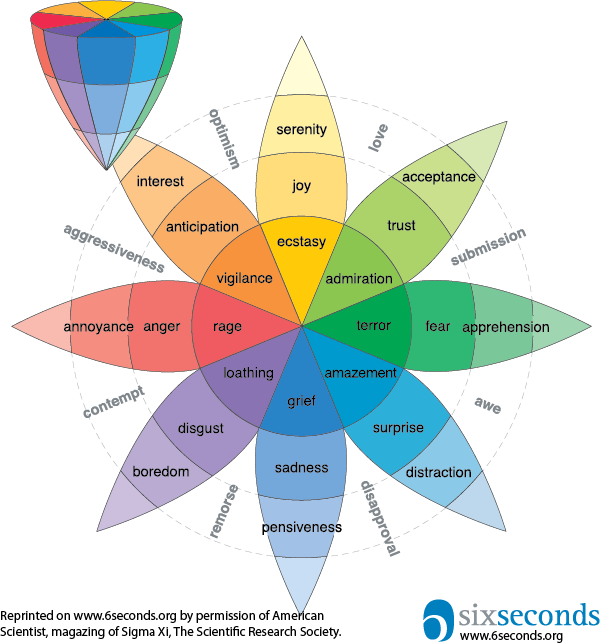
Interpreting Emotions
Primary: The eight sectors are designed to indicate that there are eight primary emotions: anger, anticipation, joy, trust, fear, surprise, sadness and disgust.
Opposites: Each primary emotion has a polar opposite, so that:
Joy is the opposite of sadness.
Fear is the opposite of anger.
Anticipation is the opposite of surprise.
Disgust is the opposite of trust.
Combinations: The emotions with no color represent an emotion that is a mix of the 2 primary emotions. For example, anticipation and joy combine to be optimism. Joy and trust combine to be love. Emotions are often complex, and being able to recognize when a feeling is actually a combination of two or more distinct feelings is a helpful skill.
Intensity: The cone’s vertical dimension represents intensity – emotions intensify as they move from the outside to the center of the wheel, which is also indicated by the color: The darker the shade, the more intense the emotion. For example, anger at its least level of intensity is annoyance. At its highest level of intensity, anger becomes rage. Or, a feeling of boredom can intensify to loathing if left unchecked, which is dark purple.
RESOURCE: For more detailed info about emotions download the Emotoscope Feelings Chart for a “back to basics” approach and build a foundation to identify your own emotions
You have the resources, now what?
I began daily brain dumps to help process my feelings and emotions. Brain dumps are literally what they sound like. They are a way to get all of your thoughts and emotions out and it’s a GREAT WAY to learn the physical steps of processing them. Brain dumps are a great way to be intentional and systematically process the things we need to.
For more on this subject join my Patreon!
Next-Level patrons and above receive monthly resources and content you won’t find anywhere else!